Most people approach Google Shopping as if performance follows a neat, predictable curve. You feed the algorithm good data, optimize your feed, improve your site and budget, and results improve in a fairly linear way.
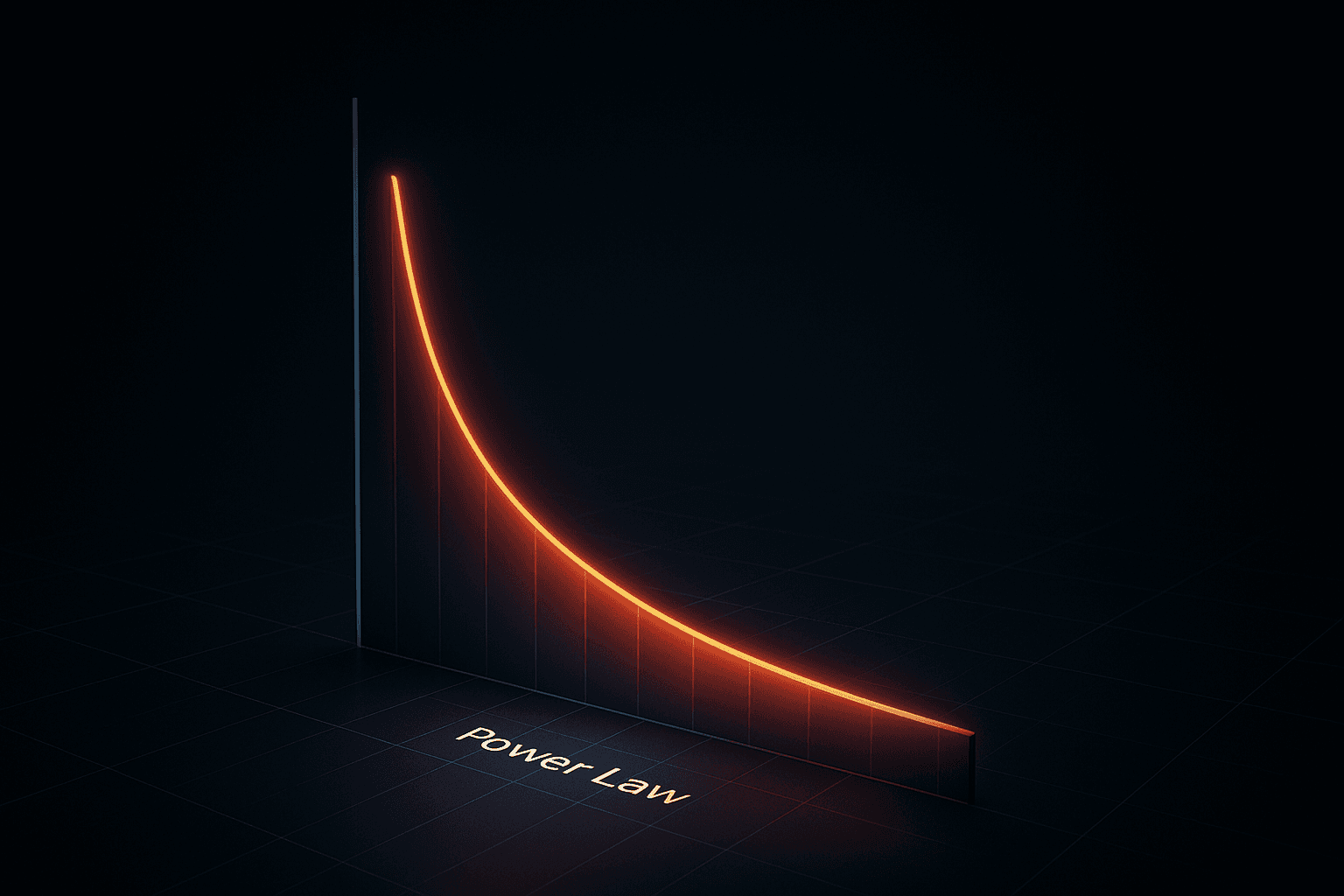
Once you operate at the scale we do, with tens of thousands of merchants flowing through the system, you discover something different. The distribution resembles a power law, not a normal distribution.
What Is a Power Law?
A power law is a mathematical pattern where a small number of events account for the vast majority of outcomes. Think of wealth distribution, city populations, earthquake magnitudes, or YouTube video views. In each case, a tiny fraction sits at the extreme end while the overwhelming majority clusters in the long tail. If you want a deeper dive into how power laws show up everywhere in nature and systems, Veritasium has an excellent explainer that breaks it down visually.
Power laws can be hard to get your head around. They are not something humans interact with directly on a daily basis normally. Our brains are wired for linear relationships and normal distributions - double the effort, double the result. Power law distributions behave differently. Yet they are all around us, governing everything from word frequency in language to the size of forest fires.
Google Shopping performance follows this exact pattern. A small number of merchants generate the overwhelming majority of the wins. The remaining merchants sit in the long tail. This pattern repeats everywhere and it carries major implications for how retailers should think about growth, budget allocation and risk.
Before we get into what this means for your own performance, it is worth breaking down what we have seen inside the data.
The Power Law Pattern We Keep Seeing
Across more than 30,000 merchants, the results fall into the same shape every year.
Around 10 merchants behave like complete outliers. Their numbers look unreal and they distort everything around them.
Around 500 merchants perform very well and scale reliably.
The remaining merchants perform anywhere from modest to barely noticeable.
Despite the surface-level differences across retailers, this pattern holds. Different verticals, different price points, different margins, different brands. The shape is always the same.
To make this concrete: we have seen one merchant generate over $2 million in sales from $180,000 in ad spend in a single quarter. Another merchant with similar product pricing and category spent $120,000 in the same period and generated $85,000 in sales. A third merchant spent $15,000 and generated $8,000 in sales.
When you are this zoomed in, looking at individual merchants, you can chalk up the differences to landing page design, conversion rate optimization, brand trust, review quality, product offering, checkout flow, and dozens of other tactical variables.
But when you zoom out and look at thousands of merchants simultaneously, a completely different pattern emerges.
Suddenly you realize there is a ceiling on every merchant. Some will do nothing regardless of optimization. Some will do modestly well. And some will be insane outliers. The ceiling depends on fundamental conditions, not tactics.
The fascinating part is that we never truly know what will happen until we run the campaigns. There are early indicators - margin structure, average order value, category demand density, existing organic conversion rates - but these are probabilistic signals, not guarantees.
We see patterns. We see correlations. But we can never be certain of outcomes. There are simply too many variables at play. Market shifts, seasonal fluctuations, competitor behavior, algorithm changes, supply chain issues, customer sentiment - all of these interact in ways that cannot be fully modeled.
We are constantly surprised by where retailers end up on the power law distribution curve and what their performance can truly be. A merchant we thought would sit comfortably in the middle becomes an extreme outlier. Another that looked perfect on paper barely moves the needle.
This is why we deliberately suppress human gut feelings. They can be proven wrong. We let the data tell us instead. Math. Not opinions. This principle is baked into our risk assessment and investment allocations per retailer. We need to learn and see what the data says before we make judgements about potential.
This is why we treat the system as a portfolio and why risk assessment is built into our model from day one. We cannot predict which specific merchant will become an outlier. But we know the distribution shape. And we know that if we fund enough campaigns across enough merchants, the portfolio math works.
You can think of each retailer as a forest. The click is a spark. One tiny spark can set off a massive fire if the forest is extremely dense and dry. The same spark does nothing in a forest that is damp, sparse or fragmented.
Google Ads works the same way.
Budget Is Not the Spark. It Is the Storm.
A lot of people assume that increasing budget creates performance by brute force. The reality is different. A bigger budget simply exposes you to more weather. More lightning strikes. More opportunities for sparks.
But the actual fire is caused by the conditions underneath. The "dense forest" is built from:
- Strong margins that allow aggressive bidding without destroying profitability
- High conversion rates driven by trust signals, reviews, and site experience
- Product-market fit in categories with genuine search demand (not manufactured hype)
- Pricing power - either through unique products, brand strength, or operational efficiency
- Repeat purchase behavior that turns one customer into many transactions
- Stock depth that prevents stockouts when momentum builds
When these conditions align, one click can trigger a cascade. A single visitor becomes a customer, then a repeat buyer, then a word-of-mouth advocate. The algorithm sees strong signals, bids more aggressively, and the flywheel accelerates.
For a retailer without these conditions, ten thousand clicks may generate modest returns and never escape the long tail.
This is why performance is so uneven. The system is working exactly as large-scale intent markets always work.
There Are Many Forests, Not One
Another mistake people make is treating Shopping as a single battlefield. In reality, you are not competing inside one forest. You are competing inside thousands of overlapping forests. Each forest represents a different cluster of queries, shopping behaviors, competitors and price contexts.
Once you zoom out enough to see all forests at once, the pattern becomes obvious. The dense forests catch fire and generate massive returns. The sparse forests never get past smoke.
RetailerBoost was built around this observation.
What This Means for Retailers
Being in the long tail is perfectly fine. Many retailers are happy in that part of the curve because the results match their goals, stock levels, margins and appetite for risk.
You do not need to be one of the extreme outliers to have a profitable Shopping channel.
The second thing is that you cannot brute force your way into the top slice with budget alone. You need the right conditions.
This is where systems and modeling help. We can identify:
- your actual ceiling
- your most valuable query clusters
- whether your margins can sustain scale
- whether your site supports rapid fire growth
- how volatile your performance is likely to be
And we can adjust strategy accordingly.
For some merchants, the best outcome is stable, predictable long-tail efficiency. For others, the conditions exist to ignite a real breakout.
Knowing the difference is half the battle.
Why Our Model Fits the Power Law
If performance is governed by a power law, then paying per click is like paying for sparks. Sparks are cheap, random and mostly useless. Only the fires matter.
This is the fundamental problem with traditional PPC. You pay for every click regardless of outcome. In a power law distribution, the vast majority of clicks sit in the long tail and generate modest or zero return. You are forced to pay for the sparks that never ignite.
When you understand that PPC performance follows a power law, it should make you question the CPC model entirely. The volatility is extreme. One month you might hit an outlier product or query cluster and achieve 15x ROI. The next month, with the same budget and strategy, you might barely break even. The unpredictability is not a bug. It is a feature of power law distributions.
Traditional CPC forces you to carry that volatility. Every click is a financial commitment before you know where it sits on the distribution curve. You are essentially gambling on whether each click will ignite a fire or just produce smoke.
That is why our model is based on funding the ads up front and taking a commission on confirmed orders only. We absorb the cost of the sparks. You only pay when the fire actually starts - when a sale completes.
Our model exists because of the mathematical reality of how these markets behave.
We Operate Like a Quantitative Portfolio Manager
We manage a portfolio of thousands of retailers simultaneously, using the same principles that quantitative hedge funds use to manage financial portfolios.
The long tail merchants provide stable, predictable returns. The strong performers in the middle generate consistent lift. The extreme outliers create disproportionate upside that compensates for the inevitable variance in the tail.
This structure only works because we fund the advertising. If every merchant had to fund their own clicks, the long tail would bleed out during the learning period. The strong performers would survive but never scale optimally. The outliers might break through, but only after burning significant capital on wasted clicks.
In the traditional PPC model, Google always wins whether you win or lose. Every click costs you money. You have to pay to play the game. The only question is: what set of rules do you want to use?
By taking on the risk and treating the system as a portfolio, we align our incentives with yours. We win when you win. We lose when you do not. This removes the adversarial relationship that exists in traditional ad buying, where the platform profits regardless of your outcome.
Our quantitative approach also means we can identify patterns faster. We see which conditions create dense forests. We see which query clusters ignite. We see when a retailer is approaching their ceiling or when they have room to scale. This intelligence feeds back into bid strategy, budget allocation, and merchant selection.
It is a system built for power law markets, not normal distributions.
How This Differs from Working with an Agency
RetailerBoost operates differently from traditional agencies and we do not compete with them directly.
Traditional agencies work on a retained fee or percentage-of-spend model. You front the advertising budget. You set the strategy. The agency executes. If you want to push a specific product line hard for Christmas, you tell them which campaigns to prioritize, how much to spend, and what the creative should emphasize. The agency gives you control, strategic input, and hands-on campaign management.
That model makes sense when you need strategic control, brand consistency, or seasonal campaign execution. But you carry the financial risk. If the campaigns underperform, you still pay the agency fee and you still spent the budget. The agency gets paid for retaining the account, not for your profit.
RetailerBoost works differently. We fund the campaigns. We take the financial risk. We run continuous risk assessments on each store and each campaign. Our decisions are always based on data, not client preference or gut instinct. We optimize for fixed ROI targets and profitability, not brand storytelling or seasonal positioning.
If you want an agency to push a specific set of products hard for Christmas, great - they can do that. If you want RetailerBoost to remove financial risk and lock in predictable returns on incremental volume, we can do that. And you can run both strategies in parallel.
We provide incrementality to what agencies do. Many of our best-performing merchants run their own Google Ads campaigns or work with agencies while also using RetailerBoost. The attribution is clean. The strategies run in parallel without conflict. You simply get more volume without more risk.
The key difference is this: agencies give you control. We give you calculated risk mitigation. Both have value. The question is which problem you are trying to solve.
You Can Benefit No Matter Where You Sit in the Curve
A power law describes a pattern, nothing more. Understanding where you sit in the distribution is liberating, not limiting.
If you are in the long tail, focus on stable efficiency, predictable costs and realistic expectations rather than forcing your way into the top slice through sheer spend. You can run a perfectly profitable Shopping channel without being an outlier.
If you are in the strong middle slice, the goal is managed scale. You have the conditions to grow, but margins matter. You need intelligent bid management and portfolio thinking to avoid overbidding on low-intent queries while capturing high-value clusters.
If you are one of the rare extreme outliers - or if you have the conditions to become one - the goal is to let the fire burn without losing control of the forest. This requires capital, systems and risk tolerance. Most retailers do not have all three. This is where a CPA model and portfolio approach become critical.
Public companies can particularly benefit from our model. We provide predictable fixed ROI and scalable growth if the foundational conditions align. For companies managing investor expectations and financial reporting requirements, having a performance channel with locked-in returns and no upfront capital risk can be a strategic advantage.
The first step is simply understanding which forest you are in. The second step is choosing a model that matches the reality of power law distributions.
If you want to explore how RetailerBoost's performance-based model works for your store, get in touch. We will review your metrics, identify your position in the curve, and show you what realistic growth looks like without the risk of paying for sparks that never ignite.